An event celebrating the 19th anniversary of the Americans with Disabilities Act (ADA) was held at the White House on July 25, 2009. ASAN President Ari Ne'eman was one of the invited guests. At the event, President Barack Obama announced that he has instructed United Nations Ambassador Susan Rice to sign the UN Convention on the Rights of Persons with Disabilities. The President also signed a proclamation commemorating the ADA and affirming the rights of people with disabilities.
Photos from the celebration and announcement ceremony can be found on the main ASAN website.
Monday, July 27, 2009

Monday, July 20, 2009
Community Choice Act Update
ASAN and many other disability rights organizations advocate the prompt passage of the Community Choice Act, which would eliminate the institutional bias in Medicaid and allow people with disabilities who need long term services and supports to live in the community. The letter below, sent to Secretary Sebelius, describes why this legislation is so urgently needed:
July 10, 2009 VIA Facsimile & E-Mail
The Honorable Kathleen Sebelius
Secretary
U.S. Department of Health & Human Services
200 Independence Avenue, SW
Washington, DC 20201
Dear Secretary Sebelius:
Thank you for your leadership this week in bringing the issue of Long Term Services and Supports back into the health care reform discussion by expressing support for including the Community Living Attendant Services and Supports (CLASS) Act in the health care reform legislation currently making its way through the Congress. As leaders of grassroots disability organizations, we write to request a meeting so that we can open up a line of communication with you and your team as health care reform takes center stage.
The disability community has advocated that reforming Long Term Services and Supports (LTSS) is a critical component of any health care reform initiative. As you know, adequate home and community services are not only preferred by seniors and people with disabilities, but also save money by avoiding serious secondary medical conditions, unnecessary trips to the emergency room, hospital stays and doctor visits. With your letter supporting inclusion of the CLASS Act, the administration has taken a first step in addressing this critical issue.
Although the CLASS Act would expand resources available to individuals and families to purchase LTSS to enable them to remain in their own homes in the community, this legislation does not:
eliminate the institutional bias in the Medicaid program which forces Americans with disabilities and older Americans into nursing facilities and other institutions;
meet the needs of seniors and people with disabilities who are already in nursing facilities or other institutions or who are at immediate risk of being forced into such a setting;
address the needs of seniors and people with disabilities who will require LTSS but won’t qualify for the proposed benefit because they are not working;
address the needs of persons who acquire disabilities earlier in life and won't qualify because they cannot secure employment;
provide any actual assistance for five years after it is enacted because people must contribute for five years before they can receive any benefit;
or meet the needs of persons with significant disabilities who would require more assistance that would be provided under this benefit.
That’s why we need the Community Choice Act (S683/HR1670).
The Community Choice Act (CCA) would eliminate the institutional bias in Medicaid and give a real option for seniors and people with disabilities who want to live in the community with LTSS.
It would address the needs of individuals who are at risk of institutional placement and give people who are already in such settings an opportunity to return to community living. CCA would provide immediate relief to Americans who are struggling with this issue, whether they were born with a disability, acquired one later in life, or are helping a family member. CCA provides a safety net for people with the most significant disabilities and allows people with incomes above the Medicaid level to buy into this program. Ultimately, the Community Choice Act brings federal LTSS policy in line with the Supreme Court’s Olmstead v. L.C. decision, giving every American with a disability the right to live in the most integrated setting.
We are writing to urge that the administration express its public support for including the Community Choice Act in the Affordable Health Choices Act. As a Presidential candidate and as a United States Senator, President Obama has expressed his support for and cosponsored the Community Choice Act. This legislation has a broad base of support within the aging and disability communities. In fact, over 80 national aging and disability organizations have endorsed this legislation.
We look forward to working with you to end the institutional bias so that every American is given a real choice in how and where they receive long term services and supports. We respectfully request a meeting with you this month to discuss how we can work together to accomplish our mutual goals.
Sincerely,
Bruce E. Darling
Organizer, ADAPT
Andrew J. Imparato
President and CEO, American Association of People with Disabilities
Ari Ne'eman
President, The Autistic Self Advocacy Network
Brenda Battat
Executive Director, Hearing Loss Association of America
Nancy J. Bloch
Chief Executive Officer, National Association of the Deaf
Kelly Buckland
Executive Director, National Council on Independent Living
Daniel B. Fisher, MD, PhD
Steering Committee Member, National Coalition of Mental Health Consumer Survivor Organizations
Chester Finn
President, Self Advocates Becoming Empowered
cc: Henry Claypool, Director, Office on Disability
July 10, 2009 VIA Facsimile & E-Mail
The Honorable Kathleen Sebelius
Secretary
U.S. Department of Health & Human Services
200 Independence Avenue, SW
Washington, DC 20201
Dear Secretary Sebelius:
Thank you for your leadership this week in bringing the issue of Long Term Services and Supports back into the health care reform discussion by expressing support for including the Community Living Attendant Services and Supports (CLASS) Act in the health care reform legislation currently making its way through the Congress. As leaders of grassroots disability organizations, we write to request a meeting so that we can open up a line of communication with you and your team as health care reform takes center stage.
The disability community has advocated that reforming Long Term Services and Supports (LTSS) is a critical component of any health care reform initiative. As you know, adequate home and community services are not only preferred by seniors and people with disabilities, but also save money by avoiding serious secondary medical conditions, unnecessary trips to the emergency room, hospital stays and doctor visits. With your letter supporting inclusion of the CLASS Act, the administration has taken a first step in addressing this critical issue.
Although the CLASS Act would expand resources available to individuals and families to purchase LTSS to enable them to remain in their own homes in the community, this legislation does not:
eliminate the institutional bias in the Medicaid program which forces Americans with disabilities and older Americans into nursing facilities and other institutions;
meet the needs of seniors and people with disabilities who are already in nursing facilities or other institutions or who are at immediate risk of being forced into such a setting;
address the needs of seniors and people with disabilities who will require LTSS but won’t qualify for the proposed benefit because they are not working;
address the needs of persons who acquire disabilities earlier in life and won't qualify because they cannot secure employment;
provide any actual assistance for five years after it is enacted because people must contribute for five years before they can receive any benefit;
or meet the needs of persons with significant disabilities who would require more assistance that would be provided under this benefit.
That’s why we need the Community Choice Act (S683/HR1670).
The Community Choice Act (CCA) would eliminate the institutional bias in Medicaid and give a real option for seniors and people with disabilities who want to live in the community with LTSS.
It would address the needs of individuals who are at risk of institutional placement and give people who are already in such settings an opportunity to return to community living. CCA would provide immediate relief to Americans who are struggling with this issue, whether they were born with a disability, acquired one later in life, or are helping a family member. CCA provides a safety net for people with the most significant disabilities and allows people with incomes above the Medicaid level to buy into this program. Ultimately, the Community Choice Act brings federal LTSS policy in line with the Supreme Court’s Olmstead v. L.C. decision, giving every American with a disability the right to live in the most integrated setting.
We are writing to urge that the administration express its public support for including the Community Choice Act in the Affordable Health Choices Act. As a Presidential candidate and as a United States Senator, President Obama has expressed his support for and cosponsored the Community Choice Act. This legislation has a broad base of support within the aging and disability communities. In fact, over 80 national aging and disability organizations have endorsed this legislation.
We look forward to working with you to end the institutional bias so that every American is given a real choice in how and where they receive long term services and supports. We respectfully request a meeting with you this month to discuss how we can work together to accomplish our mutual goals.
Sincerely,
Bruce E. Darling
Organizer, ADAPT
Andrew J. Imparato
President and CEO, American Association of People with Disabilities
Ari Ne'eman
President, The Autistic Self Advocacy Network
Brenda Battat
Executive Director, Hearing Loss Association of America
Nancy J. Bloch
Chief Executive Officer, National Association of the Deaf
Kelly Buckland
Executive Director, National Council on Independent Living
Daniel B. Fisher, MD, PhD
Steering Committee Member, National Coalition of Mental Health Consumer Survivor Organizations
Chester Finn
President, Self Advocates Becoming Empowered
cc: Henry Claypool, Director, Office on Disability
Saturday, July 11, 2009
Book Review: 22 Things a Woman Must Know if She Loves a Man with Asperger's Syndrome
Author Rudy Simone, in her first foray into the world of self-help books, seeks to address what she perceives as the concerns of women who are in romantic relationships with Autistic men. The cover blurb states that Simone, who gives presentations on autism to various groups, is "drawing on research and personal experiences to inform and advise women with AS partners."
Unfortunately, the book provides very little in the way of citations to peer-reviewed studies and instead relies heavily on stereotypes and unsubstantiated claims from Maxine Aston, who wrote the foreword. Aston asserts, without any valid research to back it up, that being involved in a relationship with an Autistic person causes "Cassandra Affective Deprivation Disorder," to which Aston attributes a variety of ailments from colds to cancer. Aston's claims have been debunked extensively on many Internet sites.
Simone has publicly stated that she is herself on the spectrum, which she learned only recently. When she first began to read about autism, she said in an interview, books by Maxine Aston and Barbara Jacobs were among the first things she found. In light of Simone's lack of a research background that would have enabled her to give their books more critical scrutiny, it is not surprising that like many young Autistics starting a career, Simone was naive and made a poor choice of mentors.
One useful suggestion in 22 Things is that an Autistic person should learn "to trust and respect his own original thinking in many matters." (p. 69) It is to be hoped that Simone will take her own advice in this regard when she pursues future projects. With her friendly, upbeat, and easily understandable communication style, she has the potential to connect well with audiences in both her speaking and writing endeavors.
Unfortunately, the book provides very little in the way of citations to peer-reviewed studies and instead relies heavily on stereotypes and unsubstantiated claims from Maxine Aston, who wrote the foreword. Aston asserts, without any valid research to back it up, that being involved in a relationship with an Autistic person causes "Cassandra Affective Deprivation Disorder," to which Aston attributes a variety of ailments from colds to cancer. Aston's claims have been debunked extensively on many Internet sites.
Simone has publicly stated that she is herself on the spectrum, which she learned only recently. When she first began to read about autism, she said in an interview, books by Maxine Aston and Barbara Jacobs were among the first things she found. In light of Simone's lack of a research background that would have enabled her to give their books more critical scrutiny, it is not surprising that like many young Autistics starting a career, Simone was naive and made a poor choice of mentors.
One useful suggestion in 22 Things is that an Autistic person should learn "to trust and respect his own original thinking in many matters." (p. 69) It is to be hoped that Simone will take her own advice in this regard when she pursues future projects. With her friendly, upbeat, and easily understandable communication style, she has the potential to connect well with audiences in both her speaking and writing endeavors.
Monday, June 29, 2009
Disability Rights Protest
ASAN members will participate in a disability rights protest occurring tomorrow, Tuesday, June 30, in Columbus, Ohio. The group will meet at Barnes & Noble (1598 N. High St.) at 9am, make a few signs and then take the bus down to the state house.
The event has been organized by Sue Hetrick and other disability advocates to protest Ohio's funding of institutions/nursing homes while cutting funding for community-based living services. More details below.
ALL OHIOANS HAVE THE RIGHT TO BE PRODUCTIVE, CONTRIBUTING, INDEPENDENT CITIZENS AND OHIO TAXPAYERS HAVE THE RIGHT TO RESPONSIBLE USE OF PUBLIC DOLLARS
When: Tuesday, June 30
Where: Ohio Statehouse, Third Street Side, Columbus
When: 8:30AM to 5 with “primetime” from 11AM to 2PM
Who: People with Any Disability, the Elderly, families, friends, advocates, and concerned Ohio taxpayers
Bring a chair, blanket, water, lunch, sunscreen or raingear!
Be prepared for a peaceful demonstration, but one that is persistent and vocal!
This is not a RALLY it is a PROTEST!
Note: As this is a grassroots demonstration no one group or individual can or will be responsible for attendant care though attendees are usually willing to support their brothers and sisters in this fight!
Signs are permitted and encouraged however they cannot be attached to sticks or poles!
Contact: Sue Hetrick 866-575-8055
The event has been organized by Sue Hetrick and other disability advocates to protest Ohio's funding of institutions/nursing homes while cutting funding for community-based living services. More details below.
JOIN US AS….
WE PROTEST
OHIO’S FUNDING OF COSTLY INSTITUTIONS/NURSING HOMES WHILE CUTTING MORE ECONOMICAL HOME AND COMMUNITY BASED SUPPORTS AND SERVICES
WE PROTEST
OHIO’S FUNDING FOR SEGREGATION OF PEOPLE WITH DISABILITIES AND THE ELDERLY THAT DENIES CHOICE IN WHERE ONE WORKS, LIVES AND SOCIALIZES
ALL OHIOANS HAVE THE RIGHT TO BE PRODUCTIVE, CONTRIBUTING, INDEPENDENT CITIZENS AND OHIO TAXPAYERS HAVE THE RIGHT TO RESPONSIBLE USE OF PUBLIC DOLLARS
When: Tuesday, June 30
Where: Ohio Statehouse, Third Street Side, Columbus
When: 8:30AM to 5 with “primetime” from 11AM to 2PM
Who: People with Any Disability, the Elderly, families, friends, advocates, and concerned Ohio taxpayers
Bring a chair, blanket, water, lunch, sunscreen or raingear!
Be prepared for a peaceful demonstration, but one that is persistent and vocal!
This is not a RALLY it is a PROTEST!
Note: As this is a grassroots demonstration no one group or individual can or will be responsible for attendant care though attendees are usually willing to support their brothers and sisters in this fight!
Signs are permitted and encouraged however they cannot be attached to sticks or poles!
Contact: Sue Hetrick 866-575-8055
Monday, June 22, 2009
Online Community for Autistic Parents
Autistic parents who are looking for information and a supportive online community may want to check out AS Parenting, a helpful website that was recently updated after a period of inactivity. The site features a blog with posts on various topics ranging from daily life with the kids to political advocacy, as well as a discussion forum.
AS Parenting is a well designed site and is easy to navigate. The administrator is a Texas mom looking to make some new friends. ASAN Southwest Ohio encourages readers of this blog to stop by and say hello!
AS Parenting is a well designed site and is easy to navigate. The administrator is a Texas mom looking to make some new friends. ASAN Southwest Ohio encourages readers of this blog to stop by and say hello!
Thursday, June 18, 2009
Celebrating Autistic Pride Day
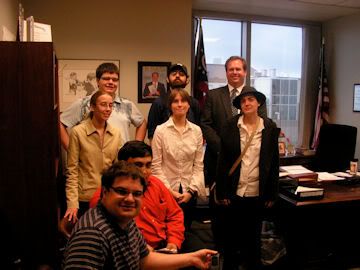
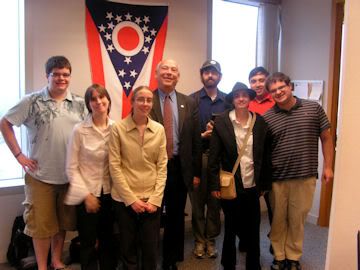
Eight ASAN members, led by ASAN Central Ohio Chapter Director Melanie Yergeau, celebrated Autistic Pride Day 2009 by visiting the Ohio statehouse yesterday and meeting with two state representatives, Rep. Kevin Bacon and Rep. Ted Celeste. The group handed out flyers and briefly explained the goals and work of ASAN.
Several people shared stories about employment, education, and community living supports during the meeting with Rep. Bacon. Melanie Yergeau explained to him that ASAN is very ideologically different from Autism Speaks. Autistic culture also was discussed and compared to other disability communities, such as Deaf culture.
The meeting with Rep. Celeste began with a discussion of the social model of disability and ASAN's participation in cross-disability communities. Rep. Celeste talked about autism insurance and was knowledgeable about ABA and the issue of excluding aversives from coverage. He thanked the group for bringing this issue to his attention. ASAN plans to follow up by sending him relevant literature and studies on aversives.
ASAN's meeting with Rep. Kevin Bacon
ASAN's meeting with Rep. Ted Celeste
Several people shared stories about employment, education, and community living supports during the meeting with Rep. Bacon. Melanie Yergeau explained to him that ASAN is very ideologically different from Autism Speaks. Autistic culture also was discussed and compared to other disability communities, such as Deaf culture.
The meeting with Rep. Celeste began with a discussion of the social model of disability and ASAN's participation in cross-disability communities. Rep. Celeste talked about autism insurance and was knowledgeable about ABA and the issue of excluding aversives from coverage. He thanked the group for bringing this issue to his attention. ASAN plans to follow up by sending him relevant literature and studies on aversives.
ASAN's meeting with Rep. Kevin Bacon
ASAN's meeting with Rep. Ted Celeste
Monday, June 15, 2009
ASAN Responds to Dr. Tony Attwood
The Autistic Self Advocacy Network recently created a petition and a statement to the community regarding the need for Dr. Tony Attwood and Dr. Isabelle Hénault to disassociate themselves from hate groups that use stereotypes and pseudoscience to incite discrimination against Autistic people in family law and relationships. We received a reply from Dr. Attwood consisting only of a form letter, sent to numerous recipients, which wholly failed to address the central issue of his and Dr. Hénault's associations with Maxine Aston and FAAAS and the ongoing harm to Autistics and others with disabilities resulting from these associations. We consider Dr. Attwood's reply grossly inadequate and have set forth a point-by-point response below, with Dr. Attwood's statements in italic formatting.
Dr. Attwood: I would like to state quite clearly that having a diagnosis of autism or Asperger’s syndrome does not render a person automatically incapable of being a good partner and parent. Indeed, many of the people I know with autism and Asperger’s syndrome as clients and friends are exceptionally good parents and partners. Should a separation occur between partners and a Court examine the issue of custody of children and access then in my opinion, any decisions should be made on the basis of the abilities of each parent and not simply assume that a parent with autism or Asperger’s syndrome is incapable of being a good parent.
ASAN: In addition to the possibility that an Autistic person might be assumed to be automatically incapable of being a good partner and parent, which is the most extreme danger posed by false stereotypes of family violence, these stereotypes have given rise to more subtle forms of discrimination in family law. FAAAS has explicitly urged family law courts and social workers to view Autistic partners and parents as more likely than others to be abusive. An article by Sheila Jennings Linehan on the FAAAS website, entitled Representing Cassandra in Matrimonial Law, characterizes the non-Autistic spouse as "a normal individual subjected to prolonged moral distress" who is not believed when she "accurately predicts future harm to her children." Along with Maxine Aston, the article specifically cites you, Dr. Attwood, as authority for such statements. FAAAS member Harriet Simons presents seminars for social workers in which she makes similar claims. Your continued association with FAAAS suggests that you endorse these false claims and, as such, increases the risk that Autistics and others with neurological disabilities will face discrimination within the family law system.
Dr. Attwood: The term “Cassandra Affective Deprivation Disorder” has been coined by Maxine Aston. It is not an official diagnostic category. I do know that stress within a relationship between an adult with Asperger’s syndrome and their partner can lead to the neurotypical partner having signs of a clinical depression. Effective relationship counselling by a counsellor knowledgeable in the area of autism and Asperger’s syndrome can significantly improve the relationship and help alleviate the signs of depression.
ASAN: By failing to acknowledge that stress within a relationship can contribute to depression for either partner, Dr. Attwood—and by your repeated endorsements of Maxine Aston in books and interviews—you are perpetuating the false claim that being in a relationship with an Autistic partner is psychologically harmful to a non-Autistic partner. There is no scientific basis whatsoever for suggesting that depression affects only the non-Autistic partner or that it is caused by affective deprivation related to the Autistic partner's responses. Several recent research studies specifically examining the affective dimensions of empathy and alexithymia found no impairment in the affective responses of Autistic individuals. (Rogers, Dziobek, Hassenstab, Wolf, & Convit, 2007; Berthoz & Hill, 2005; Silani, Bird, Brindley, Singer, Frith, & Frith, 2008.) Rather, cognitive and linguistic differences lead to misunderstandings. Thus, a presumption that the non-Autistic partner suffers from affective deprivation is unwarranted. The Autistic Self Advocacy Network recommends that those who counsel couples with one Autistic partner should adopt a nonjudgmental approach to identifying and constructively addressing misunderstandings that have occurred.
Dr. Attwood: According to my knowledge, there is no research to suggest that people with autism and Asperger’s syndrome are likely to be violent in a relationship to any greater degree than a typical person in the general population. I do know that a significant proportion of the clients that I see in my clinical practice express to me their concern in their ability to manage their temper but we now have programs such as Cognitive Behaviour Therapy to help those with autism and Asperger’s syndrome manage feelings such as anger. Problems with anger management also occur in the ordinary population but the nature of the treatment of difficulties with anger management must include an appreciation of the different experiences and cognitive profile of someone with an Autism Spectrum Disorder.
ASAN: Research studies have established that Autistics are no more likely to commit violent acts or violent crimes than the general population (Murrie, Warren, Kristiansson, & Dietz, 2002; Barry-Walsh & Mullen, 2004). Notwithstanding the scientific evidence, however, FAAAS has repeatedly and falsely stereotyped Autistics as likely to be violent and abusive toward family members and others. When interviewed in July 2008 for a Canwest News Service article, Karen Rodman, founder of FAAAS, asserted that Autistics often lose their temper for no reason. In a local news interview with the Cape Cod Times in February 2007, Rodman argued that Autistic students should be put into segregated schools because their presence purportedly could endanger other students. Dr. Attwood, by continuing to associate with FAAAS and by serving on its Professional Advisory Panel, you are in effect endorsing and lending your credibility to these harmful and prejudiced assertions. In this context, your discussion of clients seeking help for anger problems, who clearly are not a representative sample of the Autistic population as a whole, serves only to muddy the waters further.
Dr. Attwood: I have presented workshops for FAAAS for couples where one of the partners has a diagnosis of Asperger’s syndrome and in all my presentations, I have approached the issues in a very positive way examining strategies to make a successful relationship.
ASAN: In light of the clearly documented history of false stereotypes of violence and psychological harm promoted by FAAAS and other groups associated with the pseudoscientific affective deprivation concept, the Autistic Self Advocacy Network suggests that presenting couples workshops in different venues would be far more likely to result in positive and successful relationships. Dr. Attwood, we therefore reiterate our demands that you promptly disassociate yourself from Maxine Aston, FAAAS, and all similar groups and apologize to our community for the harm done by your past associations with them.
Dr. Attwood: I would like to state quite clearly that having a diagnosis of autism or Asperger’s syndrome does not render a person automatically incapable of being a good partner and parent. Indeed, many of the people I know with autism and Asperger’s syndrome as clients and friends are exceptionally good parents and partners. Should a separation occur between partners and a Court examine the issue of custody of children and access then in my opinion, any decisions should be made on the basis of the abilities of each parent and not simply assume that a parent with autism or Asperger’s syndrome is incapable of being a good parent.
ASAN: In addition to the possibility that an Autistic person might be assumed to be automatically incapable of being a good partner and parent, which is the most extreme danger posed by false stereotypes of family violence, these stereotypes have given rise to more subtle forms of discrimination in family law. FAAAS has explicitly urged family law courts and social workers to view Autistic partners and parents as more likely than others to be abusive. An article by Sheila Jennings Linehan on the FAAAS website, entitled Representing Cassandra in Matrimonial Law, characterizes the non-Autistic spouse as "a normal individual subjected to prolonged moral distress" who is not believed when she "accurately predicts future harm to her children." Along with Maxine Aston, the article specifically cites you, Dr. Attwood, as authority for such statements. FAAAS member Harriet Simons presents seminars for social workers in which she makes similar claims. Your continued association with FAAAS suggests that you endorse these false claims and, as such, increases the risk that Autistics and others with neurological disabilities will face discrimination within the family law system.
Dr. Attwood: The term “Cassandra Affective Deprivation Disorder” has been coined by Maxine Aston. It is not an official diagnostic category. I do know that stress within a relationship between an adult with Asperger’s syndrome and their partner can lead to the neurotypical partner having signs of a clinical depression. Effective relationship counselling by a counsellor knowledgeable in the area of autism and Asperger’s syndrome can significantly improve the relationship and help alleviate the signs of depression.
ASAN: By failing to acknowledge that stress within a relationship can contribute to depression for either partner, Dr. Attwood—and by your repeated endorsements of Maxine Aston in books and interviews—you are perpetuating the false claim that being in a relationship with an Autistic partner is psychologically harmful to a non-Autistic partner. There is no scientific basis whatsoever for suggesting that depression affects only the non-Autistic partner or that it is caused by affective deprivation related to the Autistic partner's responses. Several recent research studies specifically examining the affective dimensions of empathy and alexithymia found no impairment in the affective responses of Autistic individuals. (Rogers, Dziobek, Hassenstab, Wolf, & Convit, 2007; Berthoz & Hill, 2005; Silani, Bird, Brindley, Singer, Frith, & Frith, 2008.) Rather, cognitive and linguistic differences lead to misunderstandings. Thus, a presumption that the non-Autistic partner suffers from affective deprivation is unwarranted. The Autistic Self Advocacy Network recommends that those who counsel couples with one Autistic partner should adopt a nonjudgmental approach to identifying and constructively addressing misunderstandings that have occurred.
Dr. Attwood: According to my knowledge, there is no research to suggest that people with autism and Asperger’s syndrome are likely to be violent in a relationship to any greater degree than a typical person in the general population. I do know that a significant proportion of the clients that I see in my clinical practice express to me their concern in their ability to manage their temper but we now have programs such as Cognitive Behaviour Therapy to help those with autism and Asperger’s syndrome manage feelings such as anger. Problems with anger management also occur in the ordinary population but the nature of the treatment of difficulties with anger management must include an appreciation of the different experiences and cognitive profile of someone with an Autism Spectrum Disorder.
ASAN: Research studies have established that Autistics are no more likely to commit violent acts or violent crimes than the general population (Murrie, Warren, Kristiansson, & Dietz, 2002; Barry-Walsh & Mullen, 2004). Notwithstanding the scientific evidence, however, FAAAS has repeatedly and falsely stereotyped Autistics as likely to be violent and abusive toward family members and others. When interviewed in July 2008 for a Canwest News Service article, Karen Rodman, founder of FAAAS, asserted that Autistics often lose their temper for no reason. In a local news interview with the Cape Cod Times in February 2007, Rodman argued that Autistic students should be put into segregated schools because their presence purportedly could endanger other students. Dr. Attwood, by continuing to associate with FAAAS and by serving on its Professional Advisory Panel, you are in effect endorsing and lending your credibility to these harmful and prejudiced assertions. In this context, your discussion of clients seeking help for anger problems, who clearly are not a representative sample of the Autistic population as a whole, serves only to muddy the waters further.
Dr. Attwood: I have presented workshops for FAAAS for couples where one of the partners has a diagnosis of Asperger’s syndrome and in all my presentations, I have approached the issues in a very positive way examining strategies to make a successful relationship.
ASAN: In light of the clearly documented history of false stereotypes of violence and psychological harm promoted by FAAAS and other groups associated with the pseudoscientific affective deprivation concept, the Autistic Self Advocacy Network suggests that presenting couples workshops in different venues would be far more likely to result in positive and successful relationships. Dr. Attwood, we therefore reiterate our demands that you promptly disassociate yourself from Maxine Aston, FAAAS, and all similar groups and apologize to our community for the harm done by your past associations with them.
Subscribe to:
Posts (Atom)